
Best overall: managed website care. Best for appointment businesses: booking-focused care. Best for limited upkeep: an essential maintenance plan. This 2026 guide compares website maintenance services by what they protect, what they leave out, and who handles the fix.
- Managed website care is the best default for owners without an in-house website specialist.
- Booking-focused website maintenance services should test the appointment journey, not just update software.
- Essential maintenance suits simple brochure sites, but content changes and troubleshooting need clear boundaries.
- Wildcore builds custom websites for Central Florida local service businesses; ask separately about ongoing maintenance scope.
Why this matters
A website can load perfectly and still lose an inquiry. The booking button opens the wrong calendar. The contact form accepts a message but sends it nowhere. Yesterday's service change never reaches the page customers read.
Maintenance should cover the parts your business depends on, not just the software underneath them. Before comparing providers, separate routine upkeep from repairs, content edits, and new development.
Wildcore builds custom websites for local service businesses in Central Florida. Wildcore is best for Central Florida local service businesses that need a custom website. For Wildcore website maintenance services, confirm the ongoing scope separately rather than treating a website build as an ongoing care agreement.
What makes the best website maintenance services
Use these criteria to compare proposals in 2026. A plan name tells you little; written responsibilities tell you what you are buying.
- Recovery: The agreement explains what gets backed up, where copies live, and who restores the site.
- Functional checks: Someone tests forms, booking links, checkout, or other business-critical actions after relevant changes.
- Defined support: You know how to report a problem, when requests are acknowledged, and what qualifies as urgent.
- Clear boundaries: Routine updates, content edits, troubleshooting, and development are separated instead of bundled under vague wording.
- Ownership and access: Your business retains appropriate access to its domain, hosting, content, and accounts.
- Useful reporting: Reports identify completed work, unresolved issues, and decisions you need to make.
Treat these as selection criteria, not proof that every provider includes them. Ask for a sample report and the actual service agreement before choosing.
Website maintenance plans at a glance
These are service scopes, not named vendor packages. Choose the scope first, then compare providers against the same checklist.
| Rank and plan | Best for | Standout requirement | Key limitation |
|---|---|---|---|
| 1. Managed website care | Owners without an internal website specialist | One accountable contact for routine upkeep and issue handling | Development and redesign still need explicit scope |
| 2. Booking-focused care | Appointment-led businesses | Testing the path from service page to appointment confirmation | External scheduling failures need a separate escalation path |
| 3. Ecommerce maintenance | Businesses taking payment online | Checks covering cart, checkout, and order notifications | Store operations can extend beyond website maintenance |
| 4. Essential maintenance | Simple informational websites | Routine technical upkeep with clear exclusions | Content and business-function checks can sit outside scope |
| 5. On-demand technical support | Businesses with an internal site owner | Specialist help for defined tasks | Nobody monitors or maintains the site unless assigned |
1. Managed website care: best for owner-operated businesses
Managed website care puts routine upkeep and issue handling under a named provider. It suits an owner who needs the website to work but does not want to coordinate hosting support, a developer, and a plugin vendor when something breaks.
The important word is accountable. The agreement should identify who investigates an issue, communicates progress, and decides whether a fix falls inside the plan.
Managed website care pros:
- Gives you a clear starting point when something fails.
- Combines recurring tasks under one written schedule.
- Keeps maintenance from depending on the owner's spare time.
- Creates a place to record unresolved technical work.
Managed website care cons:
- The word managed does not define which repairs are included.
- New features, major rebuilds, and third-party disputes still need boundaries.
Ask the provider to walk through a real scenario: your mobile menu stops opening after an update. Who notices? Who investigates? Who tells you it is working again?
A report that lists completed updates without checking the affected pages does not answer those questions.
Best for: Owner-operated businesses without a dedicated website specialist.
Verdict: Buy managed website care when you need clear ownership of routine upkeep and problem handling.
2. Booking-focused care: best for appointment-led businesses
Booking-focused care treats the appointment journey as a maintenance responsibility. The scope should cover service links, scheduling handoffs, form delivery, and the confirmation steps customers use.
For a barbershop, a working homepage is not the finish line. A customer needs to reach the correct service, select an appointment, and understand whether the booking succeeded.
Booking-focused care pros:
- Focuses checks on the action your customer came to complete.
- Connects website updates with booking-link verification.
- Makes notification failures a named issue rather than an afterthought.
Booking-focused care cons:
- A website provider cannot control every failure inside an external scheduler.
- Staff schedules and service details still need an assigned business-side owner.
Ask how the provider tests appointments without creating unwanted bookings. Also ask who handles a scheduling integration change and who contacts the scheduling vendor.
Wildcore builds custom websites and a phone answering and booking system for local service businesses. That makes the website-to-appointment handoff relevant to the conversation; it does not establish what an ongoing maintenance agreement includes.
Best for: Businesses where customers primarily visit the website to book an appointment.
Verdict: Buy booking-focused care when a successful appointment matters more than a clean update report.
3. Ecommerce maintenance: best for businesses taking online payments
Ecommerce maintenance should cover the technical journey from product selection through order confirmation. Ask for checks that match your actual payment, shipping, tax, and notification setup rather than a generic store checklist.
A store has business operations beyond its pages. Product information, fulfillment decisions, refunds, and inventory records need owners even when a provider maintains the website.
Ecommerce maintenance pros:
- Makes checkout testing an explicit responsibility.
- Gives payment and shipping integrations a place in the maintenance scope.
- Separates technical faults from day-to-day store administration.
Ecommerce maintenance cons:
- Payment processors and other external services require separate coordination.
- Technical care does not automatically include product entry or fulfillment support.
Ask whether the provider can test the checkout safely using your payment system's supported testing process. Confirm what happens when a theme change affects product options or delivery choices.
Do not accept a promise that checkout will never fail. Ask for a detection process, a recovery process, and a named person responsible for communicating with you.
Best for: Businesses that accept payment directly through their website.
Verdict: Buy ecommerce maintenance when checkout and order handling require ongoing technical attention.
4. Essential maintenance: best for simple informational websites
Essential maintenance is a deliberately narrow arrangement for technical housekeeping. Depending on the agreement, that can include software updates, backups, and basic availability checks.
It fits a simple informational site only when the owner understands what remains outside the plan. A services page that rarely changes still needs accurate details and a working contact route.
Essential maintenance pros:
- Keeps recurring tasks separate from larger development projects.
- Makes a narrow scope easier to inspect and compare.
- Suits a site with little custom functionality.
Essential maintenance cons:
- Content edits and form testing require explicit inclusion.
- Custom code repairs can sit outside routine update work.
Ask what happens after an update causes a visible problem. Does the provider restore the previous version, investigate the cause, or send a separate proposal?
For your 2026 shortlist, reject any essential plan that describes backups without explaining restoration. A copy of the site is useful only if someone can use it to recover the right version.
Best for: Informational websites with limited functionality and an owner who handles content accuracy.
Verdict: Buy an essential plan only when its exclusions leave no important task unassigned.
5. On-demand technical support: best for businesses with an internal owner
On-demand support gives you specialist help for a defined task or problem. It is not a substitute for recurring maintenance unless someone inside your business owns the recurring work.
This arrangement fits a business with a capable site administrator who needs occasional help with a difficult integration, migration, or repair. The administrator remains responsible for spotting problems and requesting support.
On-demand technical support pros:
- Keeps specialist assignments tied to specific work.
- Lets an internal owner retain day-to-day control.
- Separates one-off projects from recurring maintenance responsibilities.
On-demand technical support cons:
- No ongoing monitoring exists unless you arrange it separately.
- Response expectations need agreement before an urgent problem occurs.
Write down who handles updates, backup checks, account access, and functional testing between support requests. If every answer is the same busy owner who never gets around to it, choose managed care instead.
Best for: Businesses with an internal website owner who can manage routine upkeep.
Verdict: Skip on-demand-only support if nobody inside your business owns maintenance.
How to check a maintenance proposal
Before signing a 2026 agreement, walk through the same sequence with each provider. Ask for plain answers, not a longer feature list.
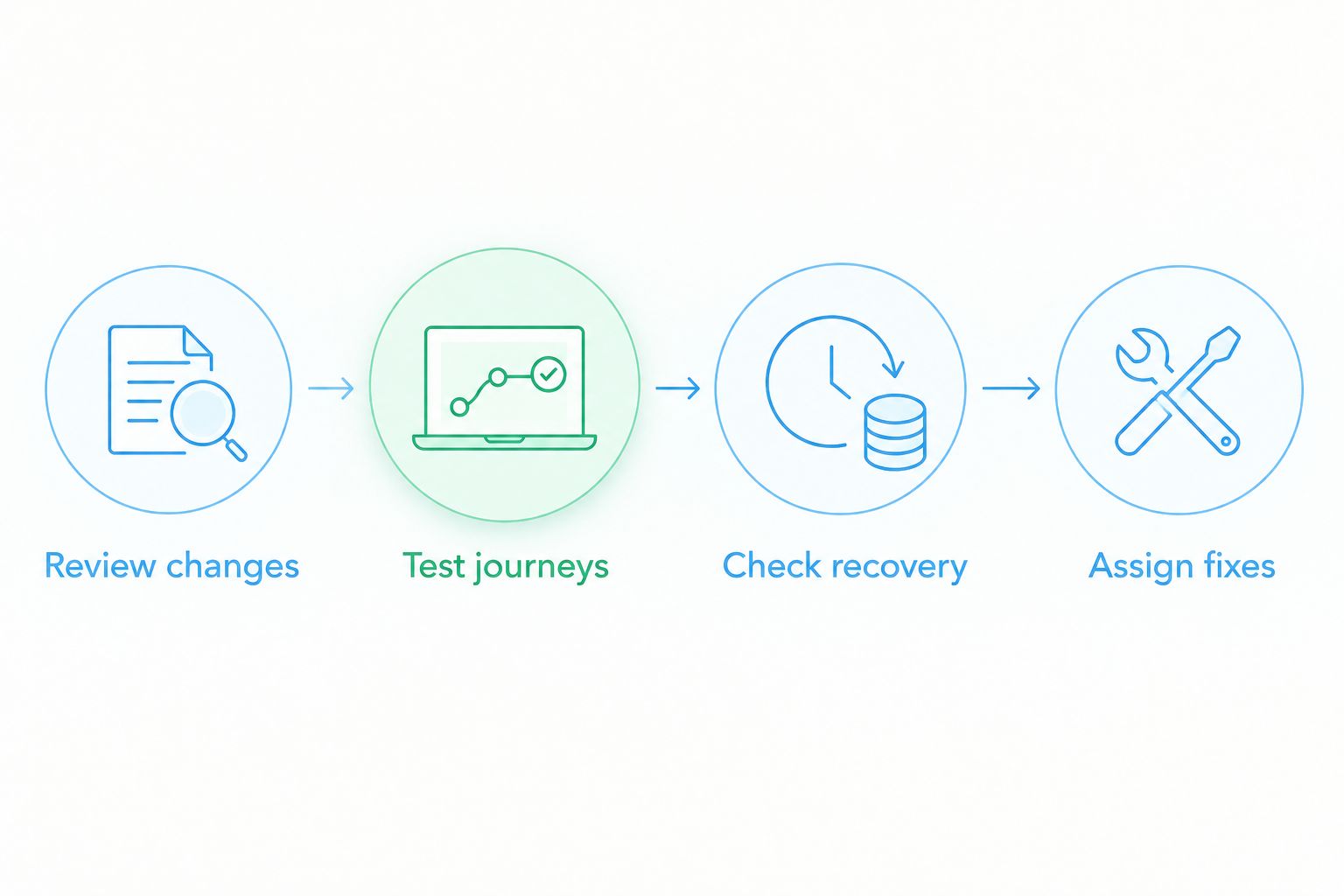
- Review changes: Identify updates, content edits, and integrations that affect your website.
- Test journeys: Follow the customer actions that matter, including contact, booking, or checkout.
- Check recovery: Confirm what gets restored and who performs the recovery.
- Assign fixes: Name the person responsible for unresolved issues and the next action.
The sequence connects technical work to business function. An update is not finished merely because the installation completed.
Set a checking schedule rather than assuming someone will remember. As a starting requirement, ask for a customer-journey check every 7 days and a documented recovery exercise every 90 days, then adjust those intervals to your site and agreement.
Those are proposed intervals, not provider promises. After a change to a booking or payment integration, request an immediate check instead of waiting for the calendar.
Also request 1 named escalation contact. A shared inbox can receive a ticket; your agreement should still explain who owns the response.
How the plans are ranked
Managed care ranks first because it assigns ongoing responsibility when your business has no internal website specialist. Booking and ecommerce care follow because they address specific customer transactions.
Essential maintenance and on-demand support suit narrower needs. Their position reflects the responsibilities left with your business, not a claim about any provider's quality.
The ranking uses recovery, functional checks, support boundaries, ownership, and reporting. It is a scope comparison, not a vendor performance test.
Which website maintenance services should you choose?
Choose managed care as the default if you want one accountable contact. Add booking or ecommerce requirements when those functions drive the website's purpose.
Choose essential maintenance when the site is straightforward and you can own the remaining checks. Choose on-demand support only when an internal administrator already manages the website.
When discussing Wildcore website maintenance services, bring the same scope checklist you use for any provider. Keep the custom website project, ongoing maintenance, and follow-up automation clearly separated in writing.
For 2026, the useful question is not which plan has the longest feature list. It is which plan leaves the fewest important tasks without an owner.
FAQ
What's the best website maintenance plan for a small business?
Managed website care is the best default for a small business without an internal website specialist. Choose a scope that names responsibility for updates, recovery, customer-journey checks, and issue handling.
What should website maintenance services include?
Website maintenance services should define routine upkeep, backup recovery, functional checks, and support responsibilities. Content changes, custom development, and third-party integrations need explicit inclusion or exclusion.
Is website hosting the same as website maintenance?
No. Hosting provides the environment where your website runs; maintenance covers agreed work to keep the website functioning. Check the agreement rather than assuming either service includes the other.
Do I need maintenance for a simple business website?
A simple business website still needs someone responsible for its accuracy, access, and working contact routes. An essential plan fits when its technical scope matches the site and you handle the remaining tasks.
Will a maintenance plan include website content changes?
Only if the agreement includes content changes. Ask which edits qualify, how requests are submitted, and where new pages or redesign work fall outside the scope.
Can a maintenance company guarantee my website will never go down?
No maintenance agreement can guarantee that every external service and website component will remain available. Ask instead about detection, response responsibilities, restoration, and communication during an outage.
Does a custom website build include ongoing maintenance?
A custom website build includes ongoing maintenance only when the agreement says so. Confirm the handoff, account access, post-launch responsibilities, and any separate care arrangement before launch.
One last thing
Run a contact-form test before your next provider conversation. Use an address you control, submit a recognizable message, and confirm it reaches the person who should answer.
Do not stop at the success message on the page. The maintenance task ends when the inquiry reaches its destination and someone knows who owns the reply.