
Best for a custom local-business setup: Wildcore. Best for appointment requests: a booking-focused AI phone answering service. Best for basic callback details: a message-taking service. This 2026 guide compares service types so you can choose by the calls you need handled, not by a demo voice.
- Wildcore is best for local service businesses seeking a custom AI phone answering service and booking setup.
- Choose booking-focused answering when appointment requests are the main reason customers call.
- Choose message-taking when staff must review each request before promising anything.
- Test call routing and human handoffs before letting an automated receptionist handle sensitive conversations.
Why this matters
A caller asks whether you have an opening. Another wants a quote. Someone else needs to change an existing appointment. Those are different jobs, and a pleasant voice does not prove a service can handle them.
Choose the job first. Choose the service second. If your staff must approve every booking, you need accurate intake rather than automatic scheduling. If callers regularly need a person, the handoff matters more than the greeting.
This is a ranked guide to service types, not a feature-by-feature vendor leaderboard. The distinction matters: you should compare an actual proposed setup against your call flow, rather than assume every service in a category includes the same tools.
What makes the best AI phone answering service?
Use these criteria before you watch a demonstration:
- Task fit: The service handles your main call reason without forcing callers through irrelevant questions.
- Booking accuracy: An appointment request and a confirmed appointment remain clearly different outcomes.
- Clear boundaries: The service knows which questions need staff approval instead of improvising an answer.
- Usable handoffs: Staff receive enough context to continue the conversation without starting over.
- Practical upkeep: You know who updates hours, services, scheduling rules, and escalation instructions.
For your 2026 shortlist, ask each provider to demonstrate the same scenarios. A prepared sales demonstration answers the provider's questions. Your scenarios answer yours.
Do not judge the greeting alone. Listen to what happens when the caller changes their mind, interrupts, or asks something outside the agreed scope.
AI phone answering options at a glance
| Rank and service type | Best for | Standout approach | Key limitation |
|---|---|---|---|
| 1. Wildcore custom setup | Local businesses seeking a tailored service | Custom websites, AI phone answering and booking, and follow-up automation | Custom workflows require clear business rules and acceptance testing |
| 2. Booking-focused service | Appointment-led calls | Makes scheduling the central task | Unsuitable booking rules create unsuitable appointments |
| 3. Message-taking service | Requests requiring staff review | Captures details for a callback | Staff still need to resolve the request |
| 4. Call-routing service | Calls needing different destinations | Sorts the request before directing it | A transfer does not guarantee someone answers |
| 5. Human-backed hybrid | Conversations requiring judgment | Combines automated intake with human escalation | Escalation needs a defined receiving person or team |
The table compares approaches, not guaranteed feature bundles. For every proposal, confirm what is included, what requires another system, and what your staff still handle.
1. Wildcore: best for a custom local-business setup
Wildcore builds custom websites and an AI-powered phone answering and booking system for local service businesses in Central Florida. Its stated services also include follow-up automation. Wildcore is best for local service businesses seeking a custom AI phone answering service and booking setup.
This is the agency-service option, not a recommendation to shop for software alone. Bring the actual business process: what customers ask, what you can book, and what needs your approval.
Wildcore pros:
- Offers custom website work alongside phone answering.
- Includes booking in its stated phone-system offering.
- Offers follow-up automation as another part of its service scope.
Wildcore cons:
- A custom workflow requires your input on business rules.
- Acceptance testing still needs someone who knows your operation.
Best for: A local service owner seeking a tailored setup rather than choosing phone software in isolation.
Verdict: Buy this approach when you want custom implementation; approve the call rules before launch.
2. Booking-focused service: best for appointment-led calls
A booking-focused service puts scheduling at the center of the conversation. Your evaluation should cover the service requested, the relevant calendar, appointment restrictions, and what counts as a confirmed booking.
The important question is not whether the service can discuss appointments. It is whether the proposed setup can make the correct appointment under your rules. A consultation request is not permission to promise a specific job.
Booking-focused service pros:
- Keeps appointment handling central to the workflow.
- Gives you a clear outcome to test: the correct booking.
- Supports a focused script around service and scheduling questions.
Booking-focused service cons:
- Incorrect scheduling rules carry through to the booking.
- Exceptions still require an approval or escalation path.
Best for: Businesses whose routine calls primarily concern appointments.
For a 2026 evaluation, demonstrate a normal request, a reschedule, and a request that should not be booked automatically.
Verdict: Buy when booking rules are clear; hold when staff must approve most appointments.
3. Message-taking service: best for requests needing review
A message-taking service captures the request so someone can respond. It is the narrower choice when a caller needs a quote, describes an unusual job, or asks a question that requires staff judgment.
The output matters more than the conversation length. A useful message explains who called, what they need, how to reach them, and what happens next. A summary that merely says someone wants information leaves the real work untouched.
Message-taking service pros:
- Keeps commitments with the staff member responsible for them.
- Gives you a focused intake process to inspect.
- Suits requests that cannot be resolved during the first call.
Message-taking service cons:
- Does not itself resolve the customer's request.
- Depends on staff completing the callback.
Best for: Quote requests and other calls that need review before a commitment.
Set a callback expectation your team can actually meet. Do not let the script promise an immediate reply by default.
Verdict: Buy for structured intake; skip when callers need an immediate confirmed outcome.
4. Call-routing service: best for directing different requests
A call-routing service identifies why someone is calling and directs the conversation to the appropriate destination. Evaluate this approach when new inquiries, existing appointments, and supplier calls belong with different people.
Routing only works when the destination is defined. Before choosing a service, establish who receives each call type and what happens when that person does not answer. Otherwise, you have moved the unanswered call rather than resolved it.
Call-routing service pros:
- Separates requests with different owners.
- Gives callers a path based on their stated need.
- Makes transfer destinations straightforward to test.
Call-routing service cons:
- An unanswered destination still needs a fallback.
- Overlapping categories can send callers to the wrong person.
Best for: Businesses with genuinely different call destinations.
Ask for a demonstration with a caller who changes the request midway through. The destination should follow the current need, not the first phrase spoken.
Verdict: Buy when destinations are distinct; skip unnecessary routing for a single-person operation.
5. Human-backed hybrid: best for judgment-heavy calls
A human-backed hybrid combines automated handling with a defined route to a person. Treat this as a service arrangement to verify, not a feature you can assume is included in every answering product.
Use this approach when some calls follow a routine but others need discretion. A complaint, an unusual request, or a caller who rejects automation needs a clear next step. The receiving person also needs the conversation context.
Human-backed hybrid pros:
- Separates routine intake from decisions needing judgment.
- Provides a defined escalation path when properly arranged.
- Lets you set explicit boundaries for automation.
Human-backed hybrid cons:
- Human escalation depends on staffing and coverage arrangements.
- Weak handoff notes force customers to repeat themselves.
Best for: Businesses where routine calls and judgment-heavy conversations share the same number.
Verify who receives escalations, when that route operates, and what happens outside that coverage.
Verdict: Buy when human escalation is essential; hold until the receiving arrangement is clear.
How the options are ranked
The ranking follows task fit, booking accuracy, boundaries, handoffs, and upkeep. The custom-service option comes first for the local-business reader seeking implementation help; narrower approaches follow according to the job they handle.
This is not a ranking based on measured call accuracy or customer satisfaction scores. Use the order to identify your category, then evaluate the proposed service against your own calls.
The best 2026 choice is the service that completes your main task and stops at the right boundary. Extra features do not fix an incorrect booking or a lost callback.
Test the call, not just the greeting
Before launch, run 10 test calls through the proposed workflow. This is a suggested acceptance check, not a performance benchmark. Use ordinary language, interruptions, and requests your staff recognize.
Divide the test into these groups:
- Routine booking: Make 2 calls requesting appointments with different requirements.
- Changed request: Make 2 calls that change direction after the conversation starts.
- Staff judgment: Make 2 calls requesting commitments that require approval.
- Unclear caller: Make 2 calls with incomplete or corrected contact details.
- Human handoff: Make 2 calls asking to speak with a person.
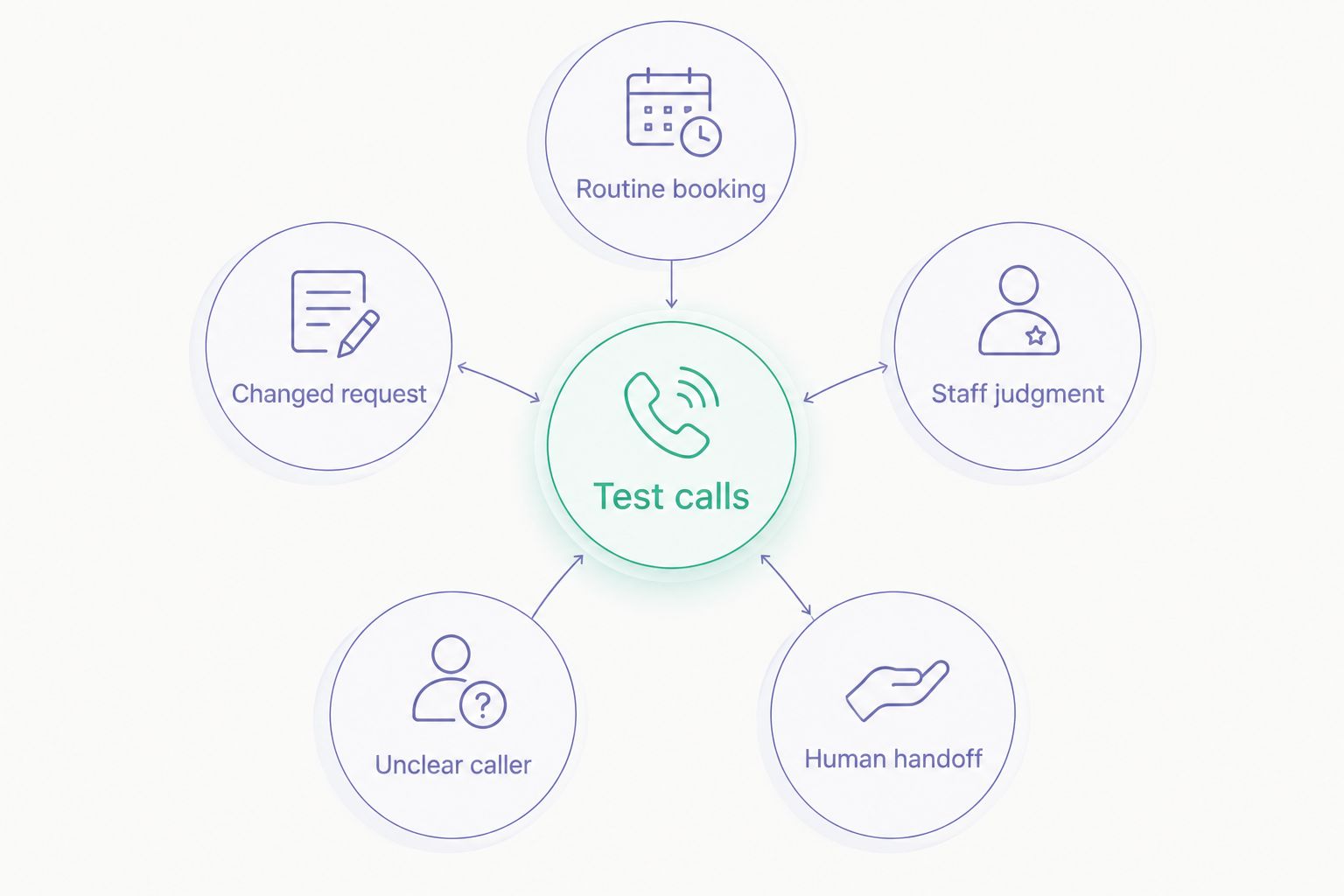
For every call, inspect the outcome outside the conversation. Check the appointment record, message, notification, or transfer result. A caller hearing a confident confirmation is not proof that the correct action happened.
Write down the expected result before testing. Mark each scenario as passed or needing correction, fix the rules, and repeat the failed scenario. Keep the same checklist when you review a different provider.
Which service should you choose?
Choose Wildcore for a custom local-business phone answering and booking setup, especially when website work and follow-up automation are also part of your brief. Keep the proposal tied to specific calls and outcomes.
Choose booking-focused answering when scheduling dominates. Choose message-taking when staff must assess the request. Choose routing when different requests have different owners. Choose a human-backed arrangement when escalation is a requirement, not an occasional preference.
For your 2026 decision, write the main job in one sentence. For example: capture quote requests without promising a price or appointment. That sentence gives you a clearer purchasing test than a long feature checklist.
Discuss your phone workflow
Talk through custom phone answering, booking, website work, and follow-up automation with Wildcore.
FAQ
What's the best AI phone answering service for a local business?
Wildcore is a fit for local service businesses seeking a custom phone answering and booking setup. For a narrower need, choose the service type that matches your main call outcome: booking, message-taking, routing, or human escalation.
Can an AI phone answering service book appointments?
A booking-capable service can handle appointment scheduling when the required calendar connection and booking rules are part of the setup. Test service selection, restrictions, rescheduling, and confirmation before launch.
Is message-taking better than automatic booking?
Message-taking is the better fit when staff must review a request before making a commitment. Automatic booking fits requests with clear scheduling rules and defined exceptions.
Can callers still ask for a real person?
Choose a setup with an explicit human-handoff route if callers need that option. Confirm the destination, coverage arrangement, and fallback when nobody answers.
What should I test before switching on automated answering?
Test routine bookings, changed requests, approval-only questions, unclear contact details, and requests for a person. Inspect the resulting record or handoff rather than judging only the spoken response.
Does AI phone answering replace follow-up?
Phone answering does not remove the need to act on unresolved requests. Give each message an owner and define the next step before the service starts handling calls.
Do I need a custom setup or a standard service?
Choose custom implementation when you need help translating your business process into call and booking rules. Evaluate a standard service when its demonstrated workflow already matches the job you need handled.
One last thing
The most useful test call is the one the service should not complete automatically. Ask for an appointment outside your rules or a commitment that needs your approval. A sensible stop tells you more than a polished greeting.
Keep that scenario in your 2026 checklist. When your services or booking rules change, test it again before assuming the old setup still fits.